
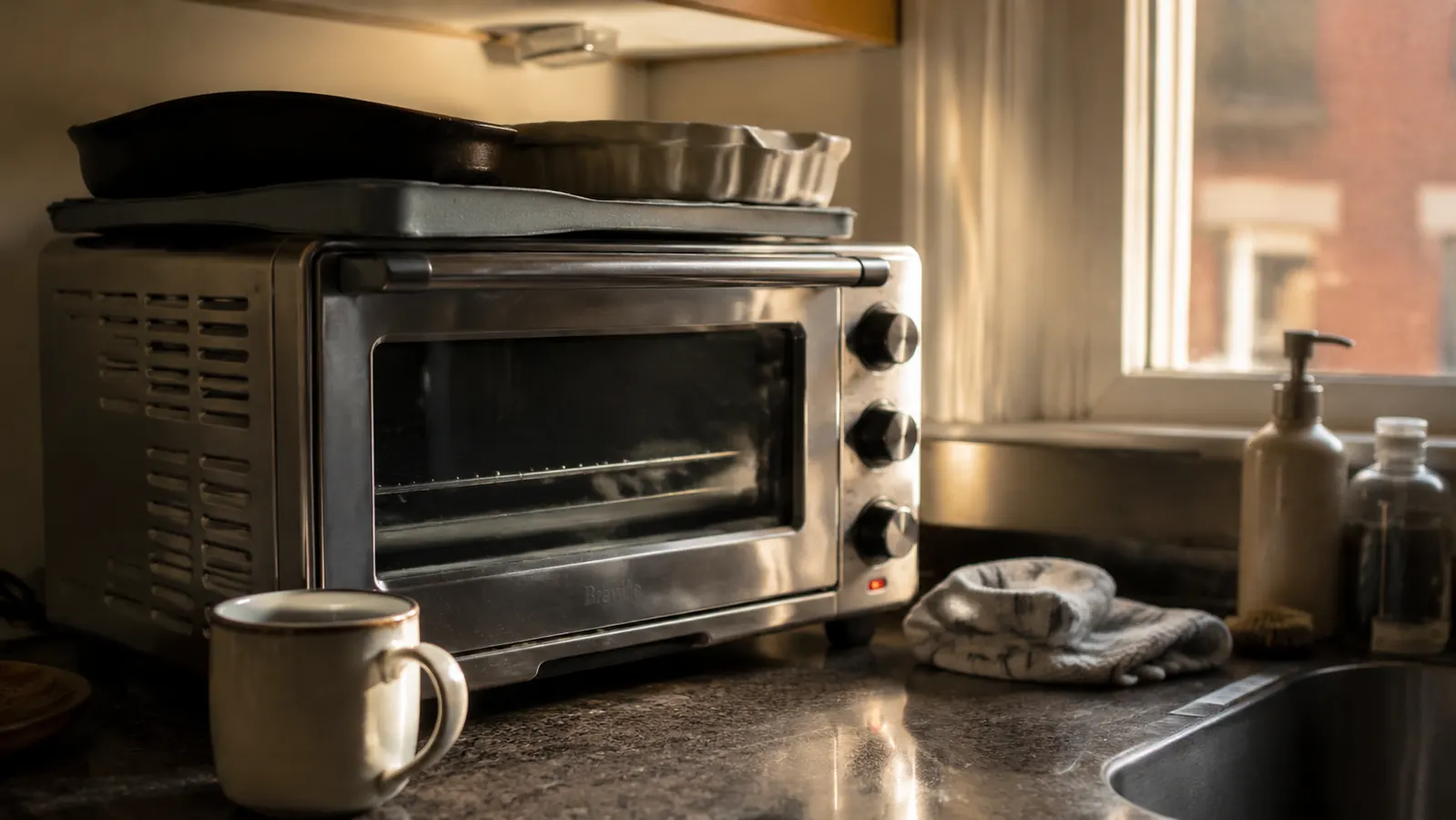
My neighbor Patrice bought the BLACK+DECKER TO1313SBD after reading the glowing reviews, and the first thing she texted me was a photo of a baking sheet that would not fit inside the oven. She had specifically bought this oven to replace her microwave for reheating and roasting, and the standard quarter-sheet pan she already owned was a full inch too wide. That was day one. By week two she had discovered the exterior gets genuinely hot, the dial does not do what she thought it would do, and one side of her toast comes out darker than the other. She still uses it every day. But she wishes someone had told her about this stuff before she bought it.
This review is that conversation. The BLACK+DECKER TO1313SBD is a legitimate, useful little oven. I am not here to trash it. It sits at a mid-range price, it has 22,000 reviews averaging 4.4 stars, and it genuinely earns its place on a small kitchen counter. But the praise is so overwhelming that the real limitations get buried, and some of them matter a lot depending on what you are planning to cook. So before you add it to your cart, let me tell you the parts that most reviews skip.
The Quick Verdict
A capable, space-friendly budget oven that heats up fast and handles daily tasks well, but its analog dial, uneven heat, and small interior cavity will frustrate you if your expectations come from a full-size range.
Amazon Check Today's Price →If you go in with the right expectations, this oven is worth every dollar.
Check today's price and availability on Amazon before deciding.
Amazon Check Today's Price on Amazon →How I Tested It (And What Patrice Tested for Me)
I borrowed Patrice's oven for two weeks after she had already broken it in. She also kept notes on her own use, so I have a combined picture from two different cooks with different habits. Patrice mostly uses it for reheating leftovers, toasting bread, and cooking frozen foods. I focused on baking, roasting small cuts of chicken, and testing whether the temperature dial is accurate.
I used an independent oven thermometer placed at different positions inside the cavity to check actual temperatures against the dial setting. I also timed preheating at several different settings, checked how hot the exterior panels get during extended use, and tried four different small pans to see which ones actually fit on the rack. I cooked roughly twelve separate meals across bread toasting, vegetable roasting, frozen pizza, reheated rice casserole, and a small batch of cookies. I took notes on every cook.
What follows is what I found, presented as plainly as I can. If you have already read ten five-star reviews, this one is meant to balance that picture.
The Temperature Problem Nobody Talks About
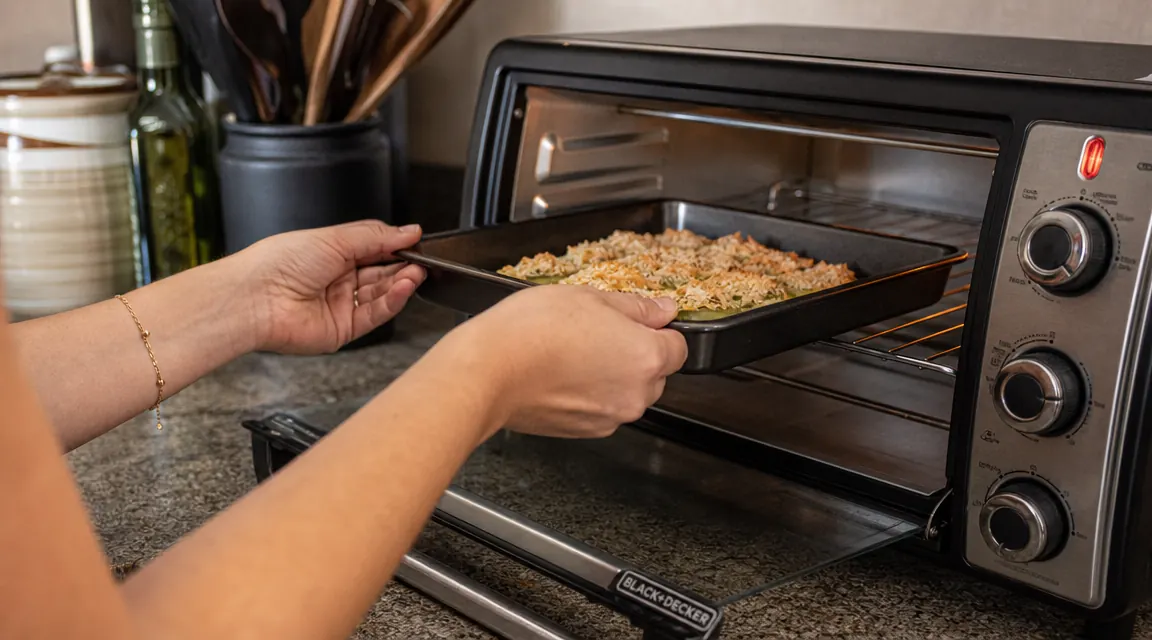
The TO1313SBD has an analog dial that goes from around 150 degrees to 450 degrees Fahrenheit. There are no digital readouts, no beeps when it reaches temperature, and no indicator beyond a small orange light. When you set the dial to 375, you are making your best guess. The oven does not confirm what temperature it has actually reached.
Using my thermometer, I found that the actual interior temperature at the 375 setting was consistently between 340 and 360 degrees at the center, and it took about eight to ten minutes to stabilize. The left side ran about 20 degrees hotter than the right. That is not unusual for a budget toaster oven, but it means food on the left browns faster. Cookies and roasted vegetables on a single tray will not finish evenly. You need to rotate them halfway through, the same way you would in a real oven with hot spots, except here the variance is more pronounced and harder to predict because the dial gives you no feedback.
If you are toasting bread or reheating a slice of pizza, none of this matters much. If you are baking something that needs a precise temperature, like a small cake or anything with a rising component, plan on checking it earlier than the recipe says and rotating once. The oven will get there. It just takes more attention than the reviews suggest.
The dial gives you a setting, not a guarantee. Budget five extra minutes and an oven thermometer if you care about accuracy.
The Pan-Fit Issue: Check Before You Buy
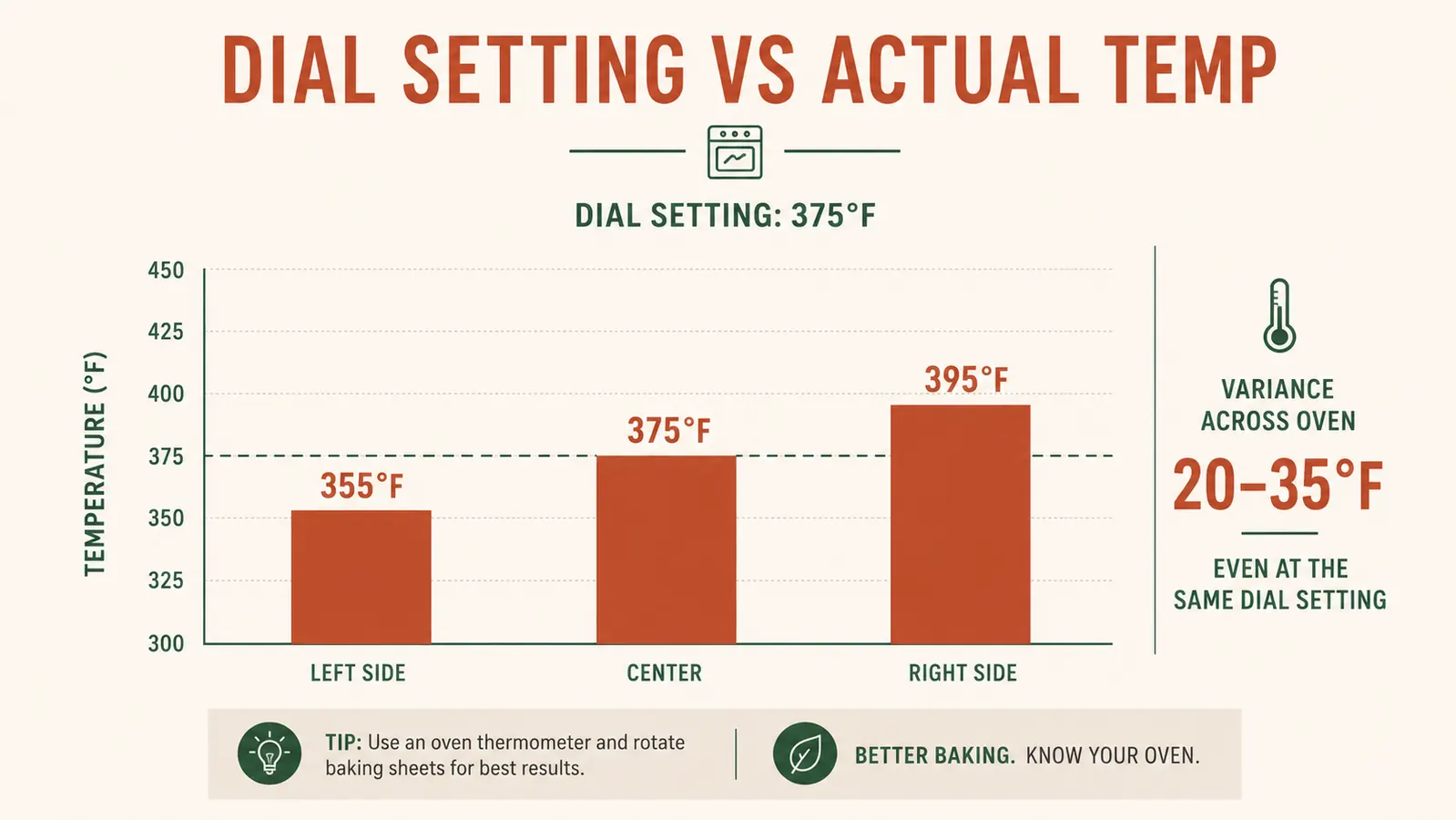
This is the one that gets people most off guard, and it is genuinely worth pausing on. The interior cavity of the TO1313SBD measures approximately 12 inches wide. A standard quarter-sheet pan, the most common small baking pan sold in most kitchen stores, is 13 by 9 inches. It will not slide in. You need a pan that is 11.5 inches wide or narrower to fit cleanly on the rack with the door closed.
BLACK+DECKER includes a baking pan in the box, and it fits perfectly. The problem is that pan is thin and dark, which means it browns the bottoms of food faster than you expect. If you buy a replacement or upgrade pan without measuring first, there is a real chance it will not fit. Patrice's situation, that photo she sent me on day one, was a standard pan from her existing kitchen collection that was just wide enough to be unusable. She had to order a separate, purpose-sized pan. That is not a dealbreaker, but it is an extra step and an extra purchase that the reviews rarely mention.
The rack that comes with the oven is wire and functional, but it is lighter than what you would find in a mid-range oven. It flexes slightly when you place a heavier dish on it. Nothing has broken in Patrice's use, but it does not feel solid when you first handle it. If you are planning to roast a small chicken or a dense casserole dish, make sure your dish is shallow enough for the door to close with clearance above it.
The Exterior Gets Hot. Actually Hot.
This one surprises people because they assume a small oven runs cool on the outside. It does not. After fifteen minutes of use at 400 degrees, the top panel of the TO1313SBD is uncomfortably warm to the touch. After thirty minutes it is hot enough that you should not rest anything on top of it, including the little notched area on the back edge that looks like it might be designed for that purpose.
The side panels get warm too, not quite hot enough to cause an immediate burn if you brush them, but warm enough that you want six inches of clearance on each side. In a very tight apartment kitchen with limited counter space and cabinet overhangs, that clearance can be hard to find. Patrice keeps hers on an open section of counter away from the wall and from her other appliances, and she places a silicone trivet on the counter underneath it because the bottom of the oven also radiates heat downward.
The front door handle stays cooler than the body, which is good. The handle is the thing you reach for most often. But the habit of grabbing the door frame or the top instead of the handle, which I caught myself doing twice, is something to watch for.
Foods It Struggles With
The TO1313SBD handles most everyday tasks well enough. Toast comes out consistent on the front and back, though not perfectly even side to side as I mentioned. Reheated pizza is genuinely better here than in a microwave, crisping the crust in about five minutes. Frozen fries and nuggets work fine. Small portions of roasted vegetables do well with some rotation. None of that is a problem.
Where it struggles: anything that benefits from convection. This oven has no fan. Heat comes from the two heating elements, top and bottom, and it circulates by natural convection only. That means the area directly in front of the back element runs hotter, and items in the center of a tray brown more evenly than items near the edges. For things like roasted broccoli or crispy chicken skin, you will get noticeably better results from a convection toaster oven. The absence of a fan is not a flaw for this price, but it is a real limitation if you have been using a convection oven and expect the same browning.
Anything delicate, like a small soufflé, a delicate sponge cake, or precise baking that relies on consistent temperature, is not the right use case here. The temperature swings are frequent enough that the results will be inconsistent. I tried a batch of twelve small sugar cookies. Eight came out well. Three were slightly underdone on the bottom, and one corner of the tray was noticeably darker. That is the honest result.
Fresh bread, anything that needs steam in the first few minutes of baking, is also not a great fit. The small cavity fills with dry heat quickly, and there is no way to add steam. Reheated bread is fine. Baking fresh bread from scratch, especially anything crusty, will disappoint.
The Crumb Tray Situation
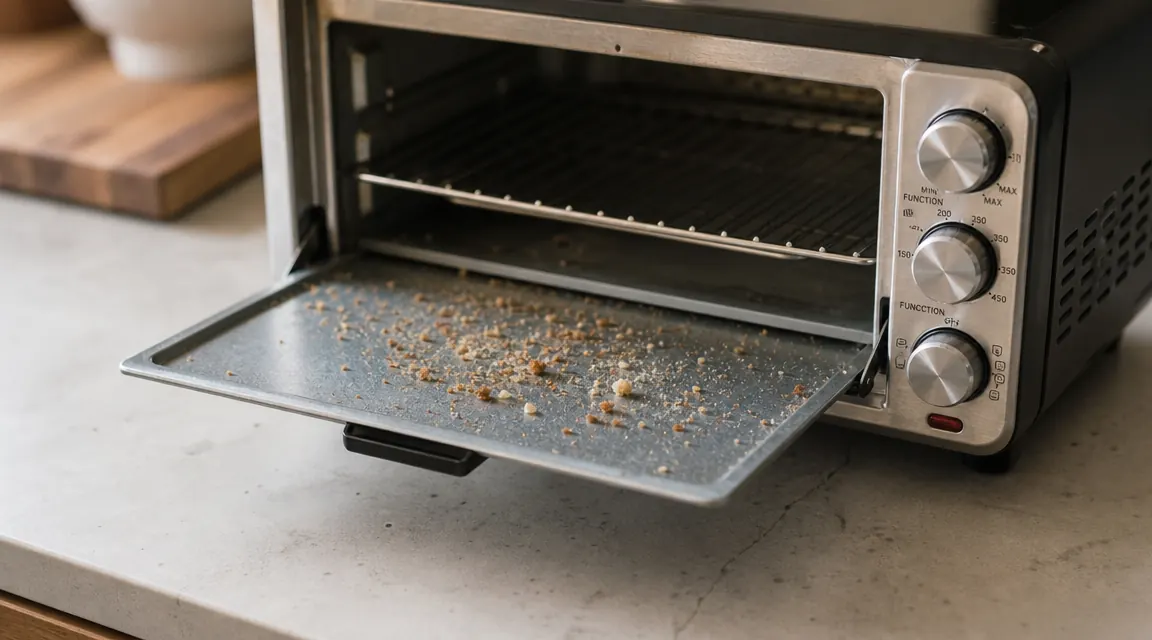
The crumb tray slides under the rack at the bottom of the oven. It catches most of the crumbs and drips that fall during cooking. In theory this is simple to clean: pull it out, tap it over the trash, rinse it. In practice, the tray fits so snugly that pulling it out always causes a small crumb cascade onto the counter. The tray does not have a lip high enough to contain crumbs during removal, so even when it is only half full, sliding it out sends a few crumbs onto whatever is underneath the oven.
This is minor, and I am being precise because it is the kind of small daily irritation that people describe in low-star reviews without saying exactly what the problem is. The fix is to pull the tray out slowly and have a paper towel ready underneath. Once you build that into the routine it takes ten seconds. But it is a small design choice that a better product would have solved, and at this price point it is worth knowing before you buy.
The crumb tray itself is not dishwasher safe according to the manual. Rinsing it by hand is easy since it is small and thin. Dried-on grease from roasting requires a quick soak, same as any pan. Nothing difficult, just not zero maintenance.
What I Liked
- Genuinely compact footprint at 15.5 inches wide, fits on tight counters without dominating them
- Preheats faster than a full-size oven, often ready in six to eight minutes
- Handles daily tasks well: toast, reheated pizza, frozen snacks, roasted vegetables in small batches
- Affordable entry price with low risk if toaster ovens turn out not to be your thing
- Includes a baking pan and rack that fit the cavity correctly, so you can cook immediately out of the box
- Timer function is reliable; oven shuts off automatically when time is up
Where It Falls Short
- Analog dial provides no temperature confirmation; actual interior temp can vary 15 to 30 degrees from the setting
- Left side runs hotter than right, requiring rotation for even browning
- No convection fan means slower, less even browning compared to step-up models
- Standard quarter-sheet pans do not fit; you need 11.5-inch or smaller pans
- Exterior panels and top surface get genuinely hot during extended cooking sessions
- Crumb tray removal scatters crumbs if you are not deliberate about it
- Thin, dark included baking pan browns the bottom of food faster than expected

Who Should Buy a Different Oven
If you bake regularly and care about consistent results, consider spending more. A convection toaster oven with a digital temperature display, something like the Cuisinart TOA-60 or the Breville Compact Smart Oven, gives you a fan for even browning and a readout that confirms your actual temperature. Those ovens cost two to three times more. If baking is your primary use case, the extra cost is justified.
If your kitchen is genuinely tiny and you need the oven to tuck into a small cabinet or slot between other appliances with minimal clearance, the heat this oven throws off on the sides and top means you need to think carefully about placement. Do not plan to slide it under a low overhead cabinet and walk away.
If you cook for more than two people regularly, the cavity is small enough that you will be running multiple batches for anything beyond a simple meal. It is designed for one to two servings. More than that and the cooking time doubles along with your patience.
Who This Is For
The TO1313SBD makes the most sense for a solo cook or a couple who wants a quick, low-effort alternative to firing up a full-size range oven for small jobs. Reheating leftovers. Toasting a few slices of bread. Cooking a small tray of frozen food. Roasting a single portion of vegetables or a chicken breast. All of that it does reliably, at a price that is easy to justify when you are working with a limited budget.
It is also a smart first toaster oven if you have never used one and are not sure how much you will actually reach for it. The low price means low risk. If it earns a permanent spot on your counter, you can decide later whether to upgrade to something with more precision. If it sits unused, you are not out much. That is genuinely valuable when you are still figuring out what your small kitchen actually needs.
Patrice still uses hers every single day, more than two months in. She just bought the right size pan, she keeps a trivet under it, and she rotates her trays halfway through anything that needs even browning. She texts me occasionally with what she made. Last week it was roasted zucchini with parmesan. It looked great. The oven did its job.
Still the right pick for solo cooks who want fast and affordable, not perfect.
Check today's price on Amazon and see current stock. It sells out periodically, especially around back-to-school season.
Amazon Check Today's Price on Amazon →