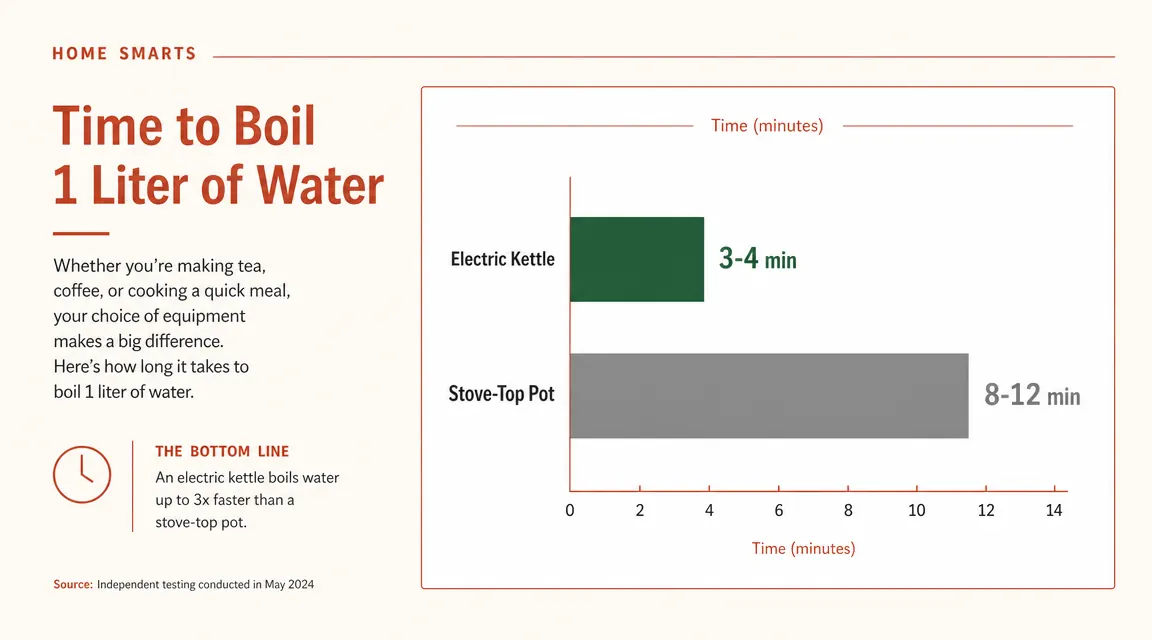
I used to stand in my tiny kitchen staring at a pot of water on the stove. Every. Single. Morning. I needed hot water for my coffee, and by the time it finally got there, I had already forgotten what I went into the kitchen for. It sounds small. But when your kitchen is the size of a walk-in closet and your stove only has two burners, those eight or ten minutes of waiting stack up in ways that genuinely grind on you.
The fix turned out to be a 1,500-watt electric kettle that costs less than a tank of gas and takes up about the same counter space as a coffee mug. The Mueller Living Electric Kettle boils a full 1.8 liters in roughly three to four minutes, which means my mornings changed overnight -- no pun intended. This guide walks through exactly how to use one to speed up every task in your small kitchen that involves hot water, from the obvious ones like tea and coffee to the ones you might not have considered yet.
Stop waiting on your stove. The Mueller kettle boils faster for less.
The Mueller Living Electric Kettle is rated 4.5 stars by over 63,000 buyers. It boils 1.8 liters in 3-4 minutes, shuts off automatically, and stores the cord so it does not tangle up your counter.
Amazon Check Today's Price on Amazon →Step 1: Choose the Right Kettle for a Small Kitchen
Not all electric kettles are made for small-space living. Some are beautiful but enormous. Some have variable temperature controls that are genuinely useful if you drink green tea or pour-over coffee, but they add cost and buttons you may never use. For most small-kitchen cooks, what you actually need is simple: fast boil, automatic shutoff, and a footprint that does not crowd your limited counter.
The Mueller Living comes in at 1.8 liters, which is enough for two to three cups of tea or a full pot of pour-over. The base is about the size of a dinner plate, and the cord storage underneath means you are not fighting a tangled wire every time you move it. If you are cooking solo or for two people, this size is exactly right -- big enough to handle pasta pre-boiling without refilling twice, small enough to slide to the edge of the counter when you are not using it.
One practical note before you buy: make sure your counter has an outlet within reach. Electric kettles need to stay on their base to heat, so a cord that stretches across the kitchen is a trip hazard and an annoyance. Most apartments have outlets above the counter near the backsplash. If yours does not, a short extension cord designed for small appliances solves the problem.
Step 2: Set Up Your Kettle in the Right Spot
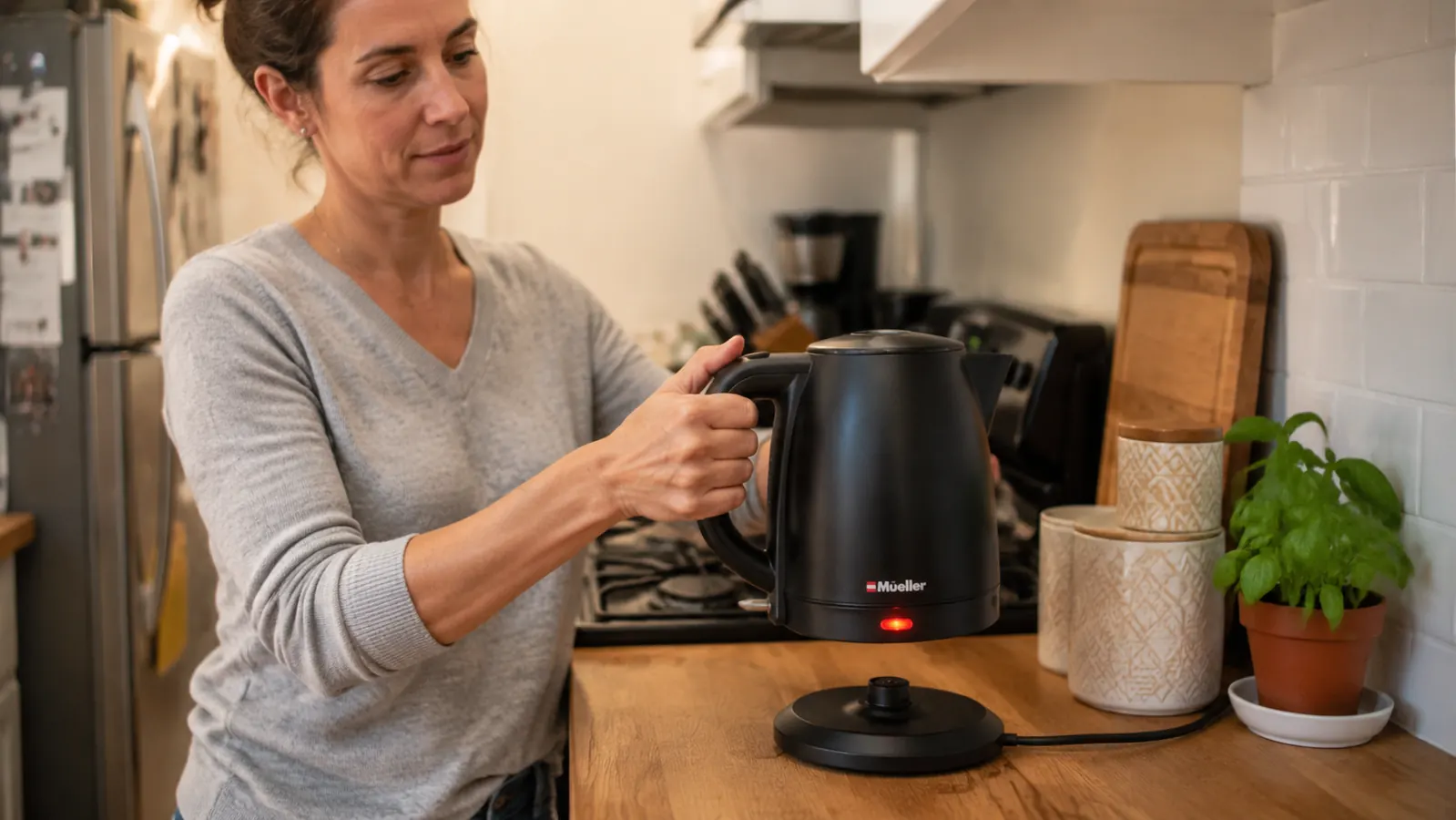
Placement matters more than you think in a small kitchen. Ideally, put the kettle base near your coffee station, your tea shelf, or wherever you reach most often when you want something hot. The whole point is to eliminate a trip to the stove and a wait while you stand there -- so the kettle should be the first thing you reach for, not the last.
In my kitchen I keep the Mueller on the right side of the counter, between the microwave and the edge. The cord wraps under the base so nothing hangs loose. When I am done using it, the kettle sits on its base and just lives there. It does not go into a cabinet. Appliances that live in cabinets get used about three times a year. Appliances that live on the counter get used every day. That is the whole philosophy.
If counter space is genuinely at a premium, you can put the base on a narrow kitchen shelf, a rolling cart, or even a small appliance stand. The kettle lifts off the base for pouring, so the base just needs to be close to an outlet and at a comfortable arm height. Some people store theirs on top of the microwave when not in use, which frees the counter entirely.
Step 3: Use It for Your Morning Drinks First
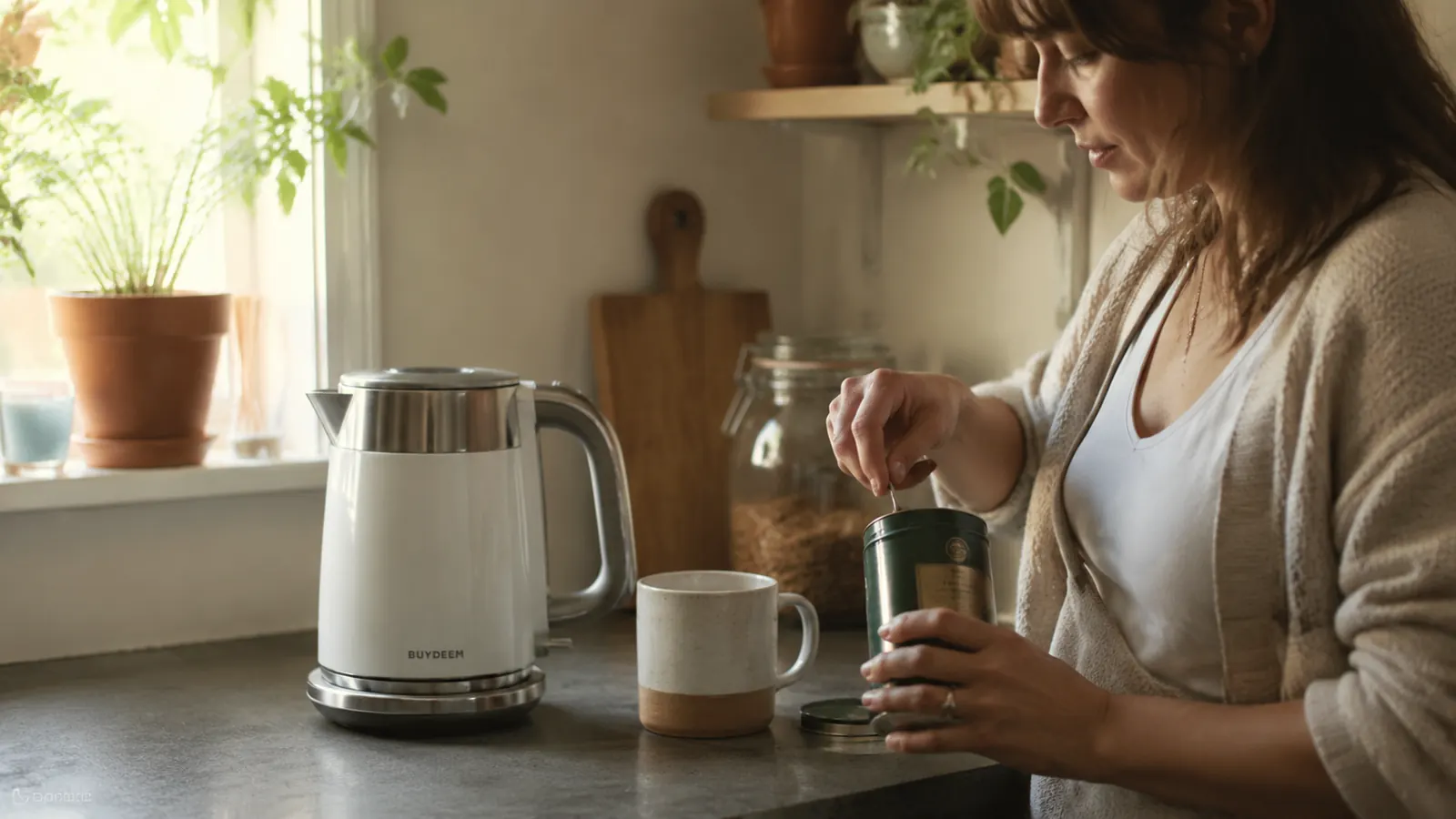
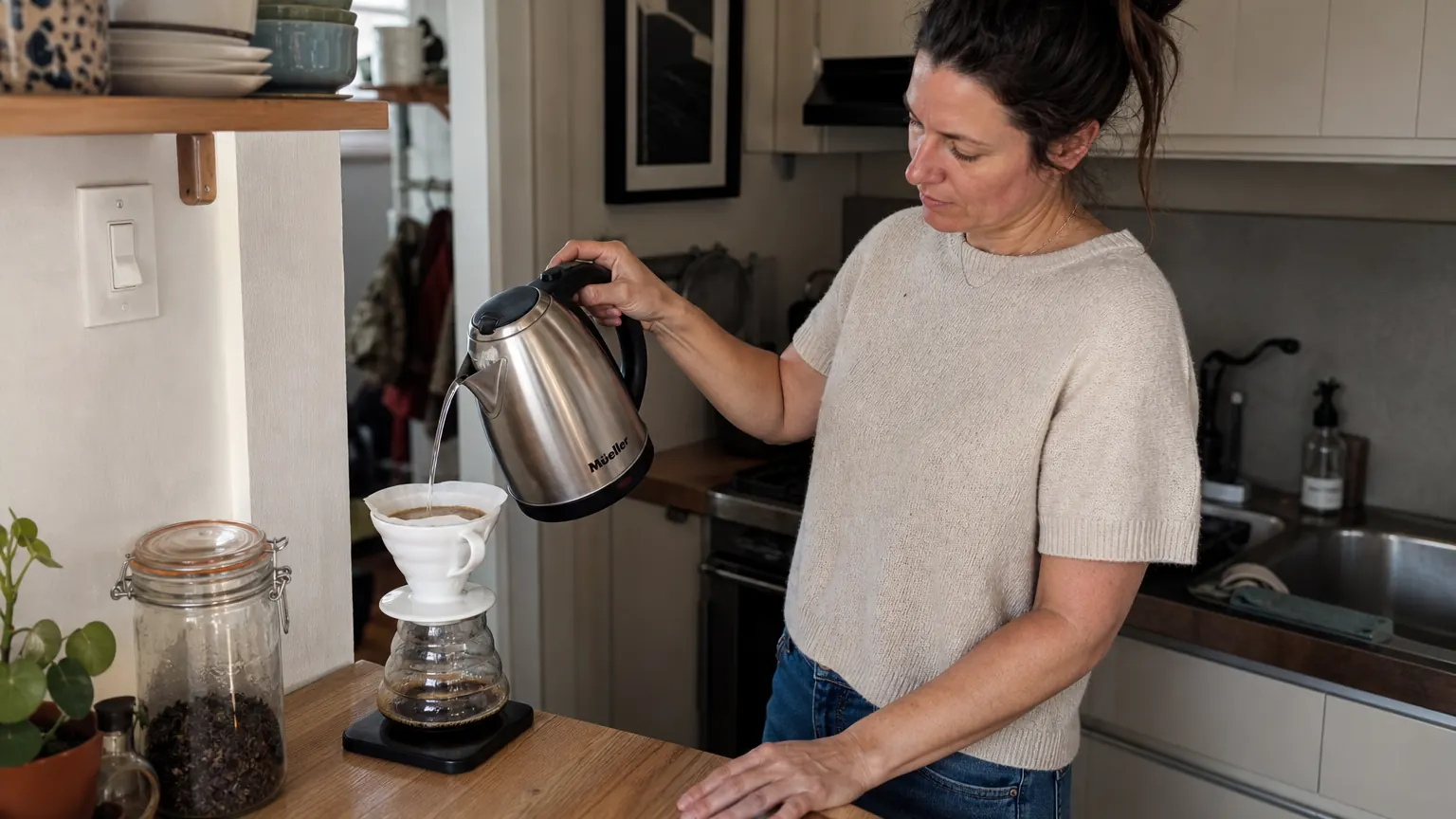
The quickest win for most people is replacing the stove for morning tea or coffee. Fill the kettle to the 1- or 1.5-liter mark, flip the switch, and go brush your teeth. By the time you come back, the water is boiled and the kettle has shut itself off. That automatic shutoff is not a gimmick -- it means you never come back to an empty, scorched kettle, and you are not tied to the kitchen waiting for a whistle.
For pour-over coffee, the Mueller works beautifully. You do not get temperature precision the way you would with a gooseneck variable-temp kettle, but for most everyday coffee, near-boiling water is exactly what you want. Just let it sit for 30 seconds after the shutoff before you pour. That brief rest drops the temperature a few degrees and keeps you from scorching your grounds. For drip coffee, instant coffee, or any pod-style brewing that requires boiled water, the kettle feeds directly into your process without any modification.
The kettle shut off by itself and the water was already boiling when I got back from feeding the dogs. I thought I had done something wrong the first time because it seemed too fast.
Step 4: Pre-Boil Water for Pasta and Grains to Cut Stove Time in Half
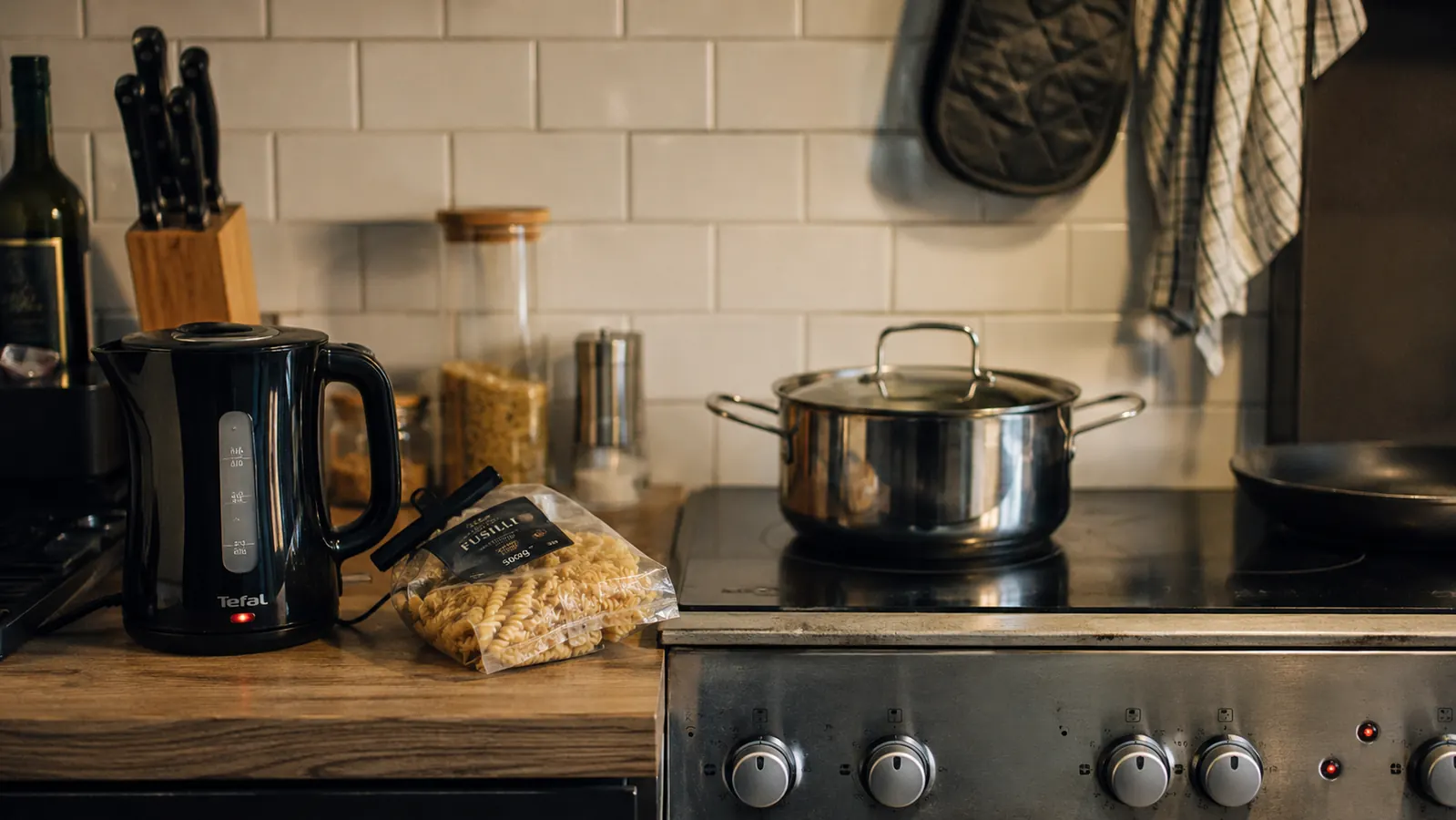
This is the step that surprises most people. You can use the electric kettle to pre-boil your water before it hits the stove pot, which cuts the stove time dramatically. Here is how it works: fill the kettle, boil it, pour the boiling water directly into your pot on the stove, then turn the stove on. Instead of bringing cold tap water up to a boil from scratch, your stove only has to maintain and finish off water that is already near boiling.
In practice this cuts my pasta-boiling time from about twelve minutes to five or six. For rice, instant noodles, oatmeal, and boxed soups, the kettle water is ready faster than the stove would be, and you skip the pot entirely -- just pour directly into a bowl. On a two-burner stove where one burner is always occupied, this also frees up your burners for the actual cooking rather than for the water prep.
One thing to keep in mind: the Mueller is 1.8 liters, which is about 7.6 cups. That is plenty for pasta for two, a full batch of rice, or multiple refills for tea. If you regularly cook for four or more people and need a large pot of water, you may need to boil the kettle twice. That is still faster than waiting for a pot of cold water on the stove, but worth knowing before you plan a dinner party.
Step 5: Expand to Everyday Tasks You Did Not Realize You Could Speed Up
Once the kettle is on your counter and part of your daily routine, you start finding uses you never expected. Blanching vegetables takes thirty seconds instead of waiting for stove water. Making instant oatmeal or grits is a thirty-second pour instead of a five-minute wait. Cleaning a greasy pan gets easier with kettle-hot water poured in to loosen everything before you scrub. If you use a French press or a moka pot, the kettle handles both beautifully.
Hot water bottles for sore muscles. Warming up a cold mug before you pour your coffee into it. Defrosting a bowl in a pinch. Steeping herbs or making a quick cup of broth on a sick day. The electric kettle earns its counter space not because it does one thing -- it earns it because it touches a dozen small tasks you already do every day and makes each one faster. That adds up in a small kitchen where your time and your space are both limited.
You can also use it for food safety tasks. Sanitizing small kitchen tools with a kettle rinse, pre-heating a thermos so your coffee stays hot longer, or softening dried fruit or mushrooms by pouring boiling water over them in a bowl rather than standing over a stove. These are not glamorous uses, but they are the kind of thing that makes you reach for the kettle almost by reflex once the habit is built.
What Else Helps When You Are Cooking in a Small Kitchen
The kettle is the single fastest win, but it works best as part of a small-kitchen system. Keeping your counter clear means the kettle stays visible and accessible rather than buried behind things. A magnetic knife strip, wall-mounted shelves for spices, and a single over-the-sink cutting board can free up several square feet of prep space without any remodeling. When your counter stays clear, the appliances that live on it actually get used.
If you are also dealing with a slow or unreliable stove, a compact toaster oven or a small air fryer covers most of what the oven handles without the preheat wait. But for anything that needs boiling water -- which is more of your daily cooking than you might realize -- the kettle is the one tool that pays for itself fastest. Most people who buy the Mueller Living use it within the first hour they have it, and it does not go back in the box after that.
For a full picture of why this one appliance earns such dedicated counter space, the article on 10 reasons every small kitchen needs an electric kettle is worth a read. And if you want to see how the Mueller holds up over a full year of daily use, the long-term review covers the build quality, the lid, and the one thing to watch out for.
The Mueller kettle: faster than your stove, smaller than a shoebox, budget-friendly.
Over 63,000 Amazon buyers rate it 4.5 stars. Boils 1.8 liters in 3-4 minutes. Auto shutoff. Cord storage built in. It is the easiest upgrade a small kitchen can make.
Amazon Check Today's Price on Amazon →